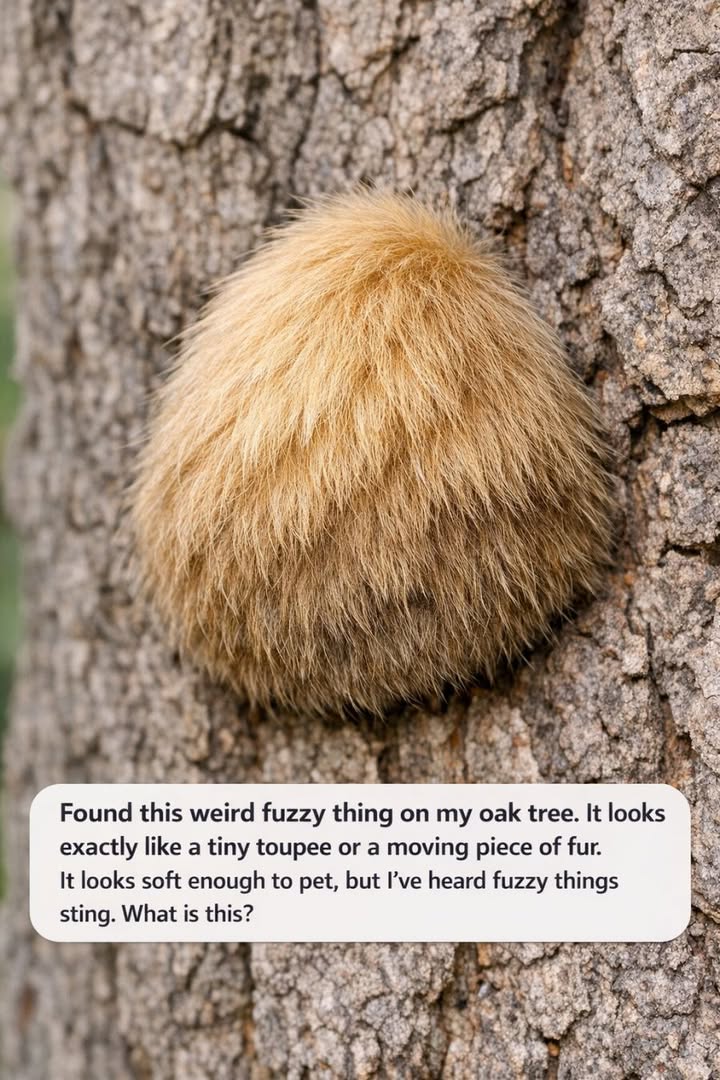

If you’ve ever wandered outside and encountered a peculiar, furry patch on your oak tree, resembling a tiny toupee or a piece of moving fur, you’re not alone. This curious creature might look harmless or even cute, leading many to wonder about its origins and nature. The temptation to touch this soft-looking anomaly might be strong, but caution is advised.
Many people are unaware that some of the most seemingly benign creatures can pose unexpected hazards. The fuzzy thing on your oak tree is a prime example. It’s important to identify and understand these creatures not only to satisfy curiosity but also to ensure safety for yourself and those around you. In this article, we’ll delve into the identity of this little furball, its habitat, its potential dangers, and how to handle an encounter with one.
1. Meet the Puss Caterpillar: The ‘Toupee’ On Your Oak Tree
The fuzzy object you’ve found is likely the puss caterpillar, also known scientifically as Megalopyge opercularis. This caterpillar is notorious for its soft, hair-like setae that resemble a miniature toupee, leading to its nickname. Typically measuring about 1 to 1.5 inches long, the puss caterpillar is one of the most venomous caterpillars in the United States.
The puss caterpillar belongs to the family Megalopygidae and is a larval stage of the southern flannel moth. Its appearance is deceptive, as its soft exterior hides venomous spines capable of delivering a painful sting. Its striking resemblance to a piece of fur or a small animal makes it both intriguing and misleading.
2. Why This Fuzzy Bug Looks So Soft (And So Misleading)
The fur-like appearance of the puss caterpillar comes from its setae, which are hair-like structures covering its body. These setae conceal small, venomous spines that can penetrate the skin upon contact, injecting toxins that cause intense pain and other symptoms.
The softness of the caterpillar is an evolutionary adaptation. The appearance of being innocuous and soft helps it avoid detection by predators. However, this same feature can trick humans into handling it, leading to unintended stings and discomfort.
3. How To Positively Identify a Puss Caterpillar On Your Tree
Identifying a puss caterpillar involves looking for its distinctive features: a teardrop-shaped body covered in dense, silky fur that ranges in color from gray to golden brown. The caterpillar is usually found on the leaves and branches of deciduous trees, especially oaks.
Another characteristic to look for is its slow, deliberate movement. Unlike other caterpillars, the puss caterpillar does not move quickly, which, combined with its unique appearance, makes it stand out among other tree-dwelling insects.
4. Where Puss Caterpillars Live And Why They Love Oak Trees
Puss caterpillars are commonly found in the southeastern United States, where they thrive in warm climates. They are often seen in late summer and fall, coinciding with their active feeding period.
Oak trees provide an ideal habitat for these caterpillars due to the abundance of leaves that serve as their primary food source. Oaks also offer a favorable environment for the caterpillars to complete their life cycle, from larval stage to moth.
5. Yes, It Can Sting: How Dangerous This Fuzzy Caterpillar Really Is
The puss caterpillar’s sting is considered one of the most painful insect stings in North America. The venomous spines beneath its fluffy exterior can cause intense pain, swelling, nausea, and in some cases, more severe systemic reactions.
While the sting is rarely life-threatening, it can cause significant discomfort and may require medical attention, especially for individuals with allergies or sensitivities to insect stings.
6. What a Puss Caterpillar Sting Feels Like, According To Victims
Victims of a puss caterpillar sting often describe the pain as immediate and intense, akin to a bee sting but longer-lasting and more severe. The pain can radiate from the point of contact, leading to muscle cramps, headache, and a rash.
Some individuals report experiencing symptoms such as nausea, vomiting, and difficulty breathing, particularly if they have an allergic reaction. The severity of symptoms can vary, but the initial pain is consistently reported as excruciating and burning.
7. First Aid: What To Do Immediately If You’re Stung
If you are stung by a puss caterpillar, it’s important to act quickly. First, remove any spines embedded in the skin using adhesive tape or a similar method to lift them out gently. Avoid using tweezers, which can push the spines deeper.
After removing the spines, wash the area with soap and water to reduce the risk of infection. Applying a cold compress can help alleviate pain and swelling. Over-the-counter antihistamines and pain relievers can also be used to manage symptoms.
8. When To See A Doctor After A Puss Caterpillar Sting
Seek medical attention if you experience severe symptoms such as difficulty breathing, chest pain, or significant swelling beyond the sting site. These may indicate an allergic reaction that requires prompt treatment.
If over-the-counter treatments do not alleviate the pain or if the sting site shows signs of infection, such as increased redness, warmth, or pus, a doctor should be consulted for further evaluation and care.
9. How To Safely Remove And Control Puss Caterpillars In Your Yard
To manage a puss caterpillar infestation, it’s important to regularly inspect trees and shrubs during their active months. Wearing gloves and using a stick or similar tool, gently dislodge caterpillars into a container for safe removal.
Professional pest control services can also be employed to manage larger infestations. Insecticides approved for caterpillar control may be used, but care should be taken to apply them according to safety guidelines to minimize impact on non-target species.
10. Protecting Kids, Pets, And Curious Neighbors From Fuzzy Stingers
Educate family members, especially children, about the dangers of touching unknown fuzzy caterpillars. Supervise outdoor play in areas where puss caterpillars are known to inhabit, and teach children to recognize and avoid these insects.
For pets, keep them on a leash or under close supervision when outside to prevent them from interacting with caterpillars. Inform neighbors about the presence of puss caterpillars, as awareness is key to preventing unwanted encounters and stings.
11. When The ‘Toupee’ Turns Into A Moth: The Caterpillar’s Life Cycle
The puss caterpillar eventually transforms into the southern flannel moth, a small, furry moth with a wingspan of approximately 1 to 1.5 inches. The moth’s coloration ranges from creamy white to yellow and orange, with fine, fluffy hairs.
The life cycle from caterpillar to moth can take several weeks to months, depending on environmental conditions. The moth stage is less of a concern in terms of stings, as it does not possess the venomous spines characteristic of its larval form. However, understanding this transformation is important for managing and predicting caterpillar populations.
