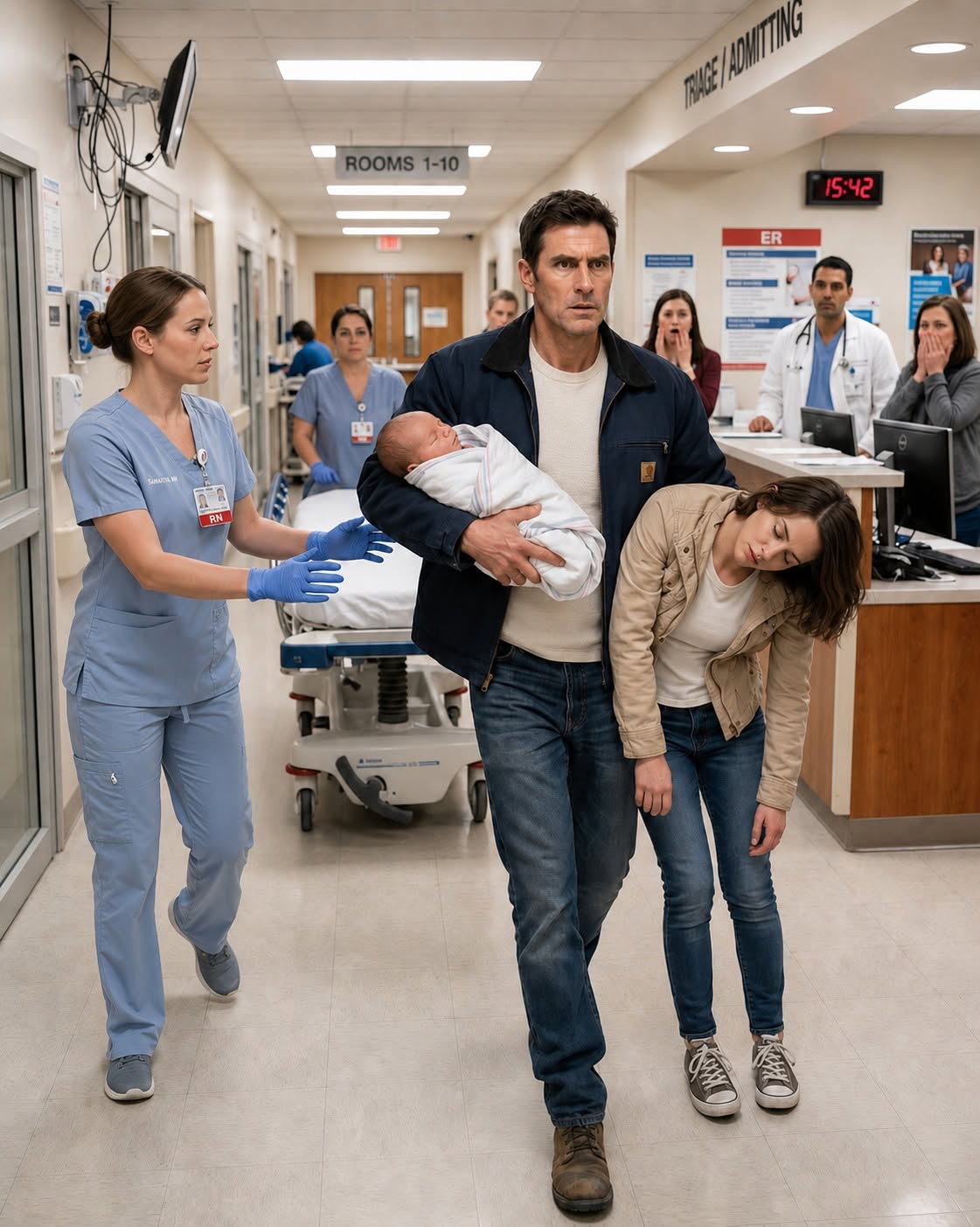

My son was only seven days old when I found him burning with fever beside his unconscious mother.
The doctor took one look at both of them and said, “Call the police.”
My name is Ethan Miller, and before that morning, I believed the worst thing a man could feel was fear.
I was wrong.
There is something worse than fear.
It is understanding that you placed the people you loved most in the hands of someone you trusted, and that trust turned into the weapon.
I lived in a working-class suburb in Ohio where every house had the same narrow driveway, the same worn patch of lawn, and the same porch lights that stayed on too long after sunset.
I worked as a warehouse supervisor for a construction supply company.
It was not glamorous, but it was reliable.
I knew inventory sheets, delayed shipments, forklift schedules, broken pallets, angry contractors, and the exact sound a man makes when he is trying not to admit he is afraid of losing his job.
My wife, Emily, carried none of that hardness.
Not because she was weak.
Because she had a way of refusing to let the world turn her cruel.
She thanked people who barely glanced at her.
She remembered birthdays.
She left extra cookies for the mail carrier in December.
She apologized when someone else bumped into her at the grocery store.
When we first moved into our small rental home, I kept saying I would fix the loose porch step, replace the scratched kitchen table, and paint the nursery before anything else happened.
Emily only smiled and said, “Home is not the paint, Ethan.”
Then she bought secondhand curtains, washed them twice, and made the room look like hope.
Seven days before everything fell apart, she gave birth to our first child.
A boy.
We named him Noah.
He entered the world red-faced and furious, with fists no bigger than bottle caps and a cry that sounded far too powerful for something so tiny.
Emily cried when the nurse laid him on her chest.
I cried too, though I turned my head because my mother was in the room and I still had that old habit of pretending I was tougher than I really was.
My mother, Linda, stood near the foot of the hospital bed with her hands folded together.
My younger sister, Ashley, kept taking pictures.
Everyone smiled.
Everyone said the right things.
My mother touched Emily’s forehead and said, “You rest now. We’ll help you.”
Ashley leaned over Noah and whispered, “You are so loved, little guy.”
I believed them.
That is the part I keep coming back to.
Not the screaming.
Not the hospital corridor.
Not even the doctor’s face when she told the nurse to call the police.
I return to that hospital room, to the soft blue cap on Noah’s head, to Emily’s exhausted smile, to my mother’s hand on her forehead.
I return to the moment before trust became evidence.
Emily came home two days later with careful instructions in a folder from the hospital.
Rest.
Fluids.
Warm meals.
Help with feeding.
Watch for fever.
Call immediately if fainting, heavy bleeding, or unusual weakness appeared.
I read every line twice.
Emily laughed at me from the bed and said, “You’re going to memorize that paper, aren’t you?”
“Yes,” I said.
She smiled. “Good.”
That was Emily.
She could turn my fear into something useful.
For two days, I hardly slept.
I warmed soup, changed diapers badly, checked Noah’s breathing every ten minutes, and helped Emily sit upright when pain crossed her face.
My mother came over with Ashley and took control of the kitchen as if it belonged to her.
At first, I felt thankful.
Mom folded towels.
Ashley washed bottles.
They told me I looked exhausted and needed to rest.
They told Emily she was lucky to have so much help.
Emily smiled politely, but when my mother stepped out of the bedroom, she squeezed my hand.
“Your mom scares me a little,” she whispered.
I kissed her knuckles and said, “She means well.”
A man can build an entire disaster on those three words.
She means well.
Four days after Emily came home, my office called before the sun came up.
I remember the exact sound of my phone vibrating against the kitchen counter.
I remember the smell of coffee I had forgotten to drink.
I remember Noah hiccupping in the bassinet and Emily sleeping with one hand on the blanket, as if even asleep she was still trying to protect him.
My manager sounded panicked.
There was a serious issue at another branch.
Missing stock paperwork.
A supplier threatening legal action.
A delivery that had been signed out under my supervision weeks earlier.
I told him no.
“My wife just had a baby,” I said. “My son is not even a week old.”
He lowered his voice.
He said it would only take four days.
He said the company could lose a major account.
He said if the files were not sorted out, people above both of us would begin asking why my signatures were attached to missing materials.
I looked down the hallway toward the bedroom.
The house was quiet.
The dryer thumped softly.
Rain tapped against the window.
I should have said no again.
I should have hung up.
I should have walked into that bedroom, climbed beside my wife and son, and let the job burn if it wanted to.
Instead, I allowed fear to dress itself as responsibility.
I called my mother.

She came over with Ashley by noon.
I stood in the kitchen with my duffel bag near my feet, feeling as if every object in the house was accusing me.
The baby bottles drying beside the sink.
The hospital folder on the counter.
Emily’s slippers beside the bedroom door.
“Please,” I told them, “just take care of her. She’s weak. She needs food, water, rest, and help with Noah. The discharge papers are right here.”
My mother touched my cheek.
“Ethan, she is family,” she said. “Go save your job. Your wife and my grandson will be safe.”
Ashley rolled her eyes like I was being dramatic.
“Stop acting like only you love them,” she said. “We’ve got this.”
Before leaving, I went into the bedroom.
Emily was awake.
Noah was asleep against her side.
“I hate this,” I said.
She looked exhausted, but she still tried to comfort me.
“Go,” she whispered. “Come back fast.”
I kissed her forehead.
Then I kissed Noah’s tiny fist.
His fingers opened and closed around nothing.
I did not know that would be the last peaceful moment I would have for a very long time.
During the trip, I called home constantly.
Morning.
Lunch break.
After meetings.
Before bed.
Every time, my mother answered.
Every time, she controlled the phone like a guard posted at a locked door.
She would turn the camera for two or three seconds.
Emily would be on the bed, pale and unmoving.
Sometimes her eyes were open.
Sometimes they were not.
Once, she whispered, “Eth…”
My mother immediately pulled the phone back.
“She’s emotional,” she said. “All new mothers are like this. Don’t make her weaker.”
I asked whether Emily was eating.
Mom said yes.
I asked whether she was drinking water.
Mom said yes.
I asked whether Noah was feeding.
Ashley answered from somewhere off camera, “He’s fine. He cries because he’s a baby.”
On the second day, I heard him crying.
It was not the full, angry cry from the hospital.
It was dry.
Thin.
Like a sound scraped raw.
“Put the camera on him,” I said.
“He just fell asleep,” my mother replied.
“He’s crying right now.”
“Then he’s almost asleep.”
Her voice held irritation.
Not concern.
I told myself I was exhausted.
I told myself I was hearing things through a poor connection.
I told myself my mother had raised two children, and I was a new father who knew nothing.
That is the thing about family.
Sometimes the history you share becomes the blindfold you wear.
On the third day, Emily finally got the phone for a moment.
Her face filled the screen, half-shadowed by the bedside lamp.
Her lips looked cracked.
Her hair was damp at her temples.
“Ethan,” she whispered.
I sat up in the motel bed.
“What’s wrong?”
Her eyes shifted toward the door.
Before she could answer, the phone moved.
My mother’s face appeared.
“She dropped it,” Mom said.
“What did she want to tell me?”
“She wants attention. You know how women get after birth.”
“No,” I said. “I don’t know that.”
My mother’s expression hardened.
“I had two babies without turning the house upside down,” she said. “Your wife is not a princess.”
I went silent.
I hate that silence now.
I hate it more than anything I said later.
Because silence can sound like permission when the wrong person is listening.
On the fifth night, the work ended earlier than expected.
I did not tell anyone.
I packed my duffel bag, signed the last paperwork, and drove through the dark with gas station coffee burning my tongue.
Rain tapped the windshield in light, steady beats.
The highway signs glowed green.
My phone sat in the cup holder.
I called once at midnight.
No one answered.
I called again at 1:16 a.m.
Nothing.
At 2:03 a.m., Ashley texted, “Everyone asleep. Stop worrying.”
I stared at those words for a long time.
Then I drove faster.
I reached our neighborhood before sunrise.
The street looked rinsed clean by the rain.
A trash can had tipped near the curb.
A porch flag next door hung limp in the damp air.
The windows of our house were dark except for the living room.
I parked crookedly in the driveway and left my duffel bag in the truck.
The moment I opened the front door, I knew something was wrong.
A newborn home has sounds.
Tiny grunts.
Soft footsteps.
Water running.
A microwave humming at strange hours.
A mother shifting in bed before the baby fully cries.
Our house had none of that.
It had cold air.
The smell of old pizza.
A sourness beneath it that I would only identify later.
The living room light was on.
My mother and Ashley were asleep on the couch beneath the air-conditioning, wrapped in thick blankets.
Pizza boxes sat open on the coffee table.
Crushed chip bags lay beside empty Coke bottles.
The TV screen had gone black, but the blue light from the cable box blinked like a pulse.
My mother opened her eyes.
For one second, she looked confused.
Then afraid.
“Ethan?” she said. “Why didn’t you tell us you were coming?”
I did not answer.
“Where’s Emily?”
“In the bedroom,” she said, sitting up. “Your son cried all night. She’s probably sleeping now.”
That was when I heard Noah.
Not crying.
Not exactly.
It was a thin, fractured sound from behind the half-closed bedroom door.
Like a tiny animal trapped somewhere too hot.
I ran.
The smell reached me before the sight did.
Sour milk.
Sweat.
Blood.
Stale diapers.
The windows were closed.
The fan was off.
The room felt like the inside of a locked car in July.
Emily lay on one side of the bed.
Her hair clung to her forehead.
Her shirt was soaked across the chest.
Her face looked gray in the early light.
Continue reading on the next page
