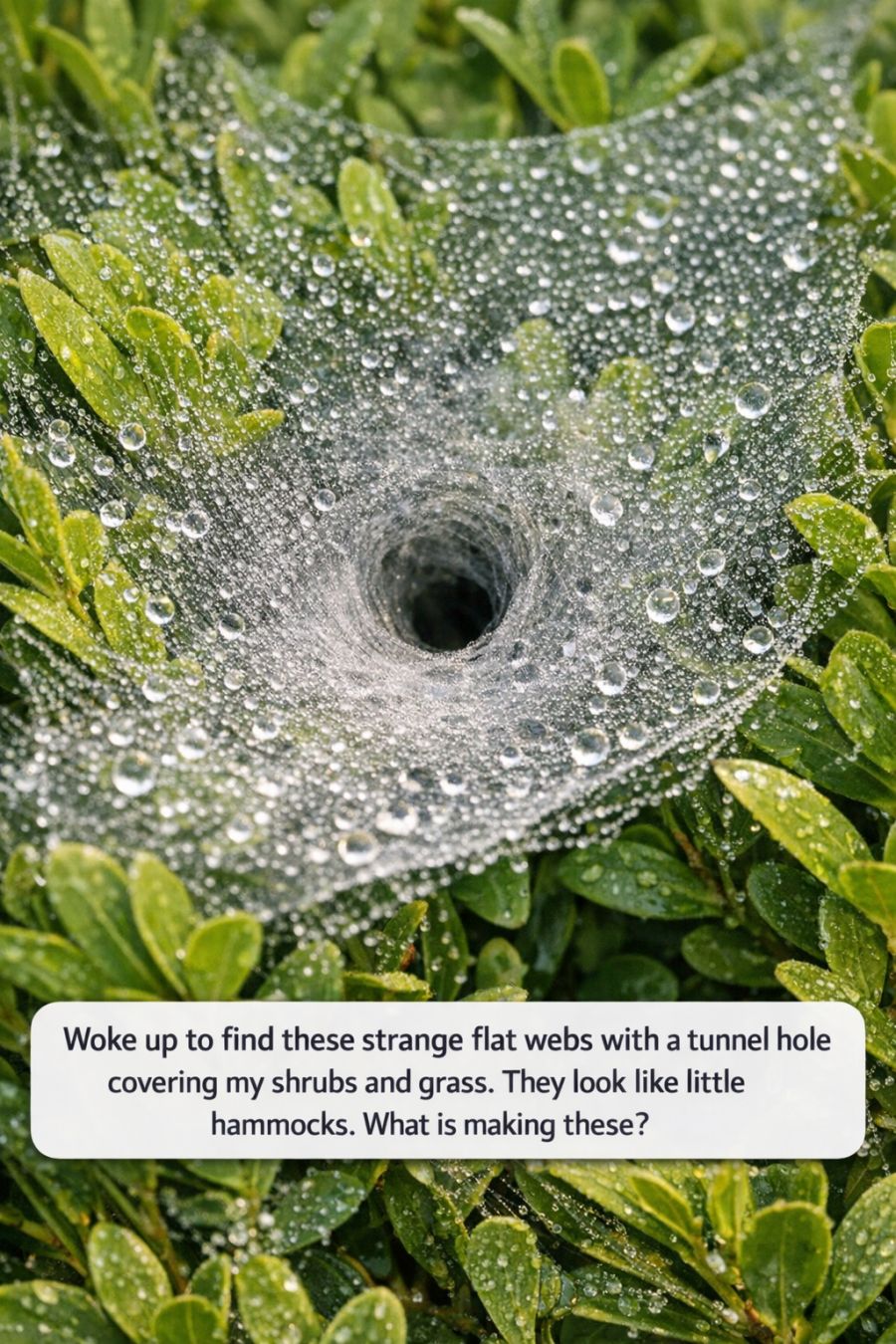
Imagine waking up one morning to find your once pristine lawn and shrubs now draped in peculiar flat webs. These webs, resembling little hammocks, often have an intriguing tunnel hole leading into them, sparking curiosity and perhaps even concern. What could be the mysterious creators behind this sudden transformation of your garden?
This article aims to unravel the mystery behind these strange web formations, identifying their creators and understanding their role in the ecosystem. We will explore the characteristics of these webs, differentiate them from other types, and provide insights on how to manage their presence if necessary.
1. Those Mysterious Hammock-Like Webs Are Funnel Weaver Spider Homes
These peculiar hammock-like webs are the handiwork of funnel weaver spiders, also known as Agelenidae. These spiders construct sheet-like webs that are flat and dense, often measuring several feet across. At one end of the web, a funnel-shaped retreat serves as a hideout for the spider. The web acts as a trap, with the spider lying in wait for unsuspecting prey to stumble onto the sticky surface.
Funnel weaver spiders are adept at building these webs overnight, often leaving homeowners puzzled by their sudden appearance. Unlike orb weaver spiders that spin large circular webs, funnel weavers prefer these flat, sheet-like constructions that allow them to quickly dart out from their funnel to capture prey.
2. How To Tell Funnel Weaver Webs From Cobwebs And Orb Webs
Funnel weaver webs are distinct in their construction. They differ from cobwebs, which are irregular and often found in corners or undisturbed areas of the home. Orb webs, on the other hand, are the classic spiral webs associated with garden spiders and are typically suspended between trees or structures.
The key characteristic of funnel weaver webs is their flat, sheet-like appearance with a tunnel or funnel at one end. These webs are often found close to the ground or on shrubs, unlike orb webs that are elevated. Additionally, funnel weaver webs are not sticky, relying on their structure and the speed of the spider to capture prey.
3. Why These Flat, Sheet-Like Webs Appear Overnight On Lawns And Shrubs
The sudden appearance of these webs can often be attributed to environmental conditions. Funnel weaver spiders are particularly active in the late summer and early fall when they are in their mating season. During this time, male spiders are more mobile and may construct webs in new locations as they search for mates.
Additionally, dew-laden mornings can make these webs more visible, as the moisture highlights their intricate structure. The spiders take advantage of the cool, humid nights to spin their webs, which can seem to appear out of nowhere by morning.
4. Meet The Builders: Grass Spiders And Other Common Funnel Weavers
Grass spiders, a common type of funnel weaver, are known for constructing these webs in grassy areas. These spiders are generally small, with body lengths ranging from 10 to 20 millimeters. They are characterized by their brown and gray coloration with distinctive stripe patterns on their bodies.
Other common funnel weavers include the Agelenopsis species, which are frequently found in North America. These spiders are harmless to humans and play a vital role in controlling pest populations by preying on insects.
5. The Tunnel Hole: What’s Really Hiding Inside That Web Funnel
The tunnel or funnel in these webs serves as a retreat for the spider. It is a strategic location where the spider can hide from predators and wait for prey to venture onto the web. The funnel allows the spider to quickly dart out and capture its prey with remarkable speed and agility.
Inside the funnel, the spider is well-protected and can monitor vibrations on the web to detect the presence of prey. This hideout is an essential part of the spider’s hunting strategy, making the web both a trap and a home.
6. Are Funnel Weaver Spiders Dangerous To People Or Pets?
Funnel weaver spiders are generally not dangerous to……
Read more on the second page below
