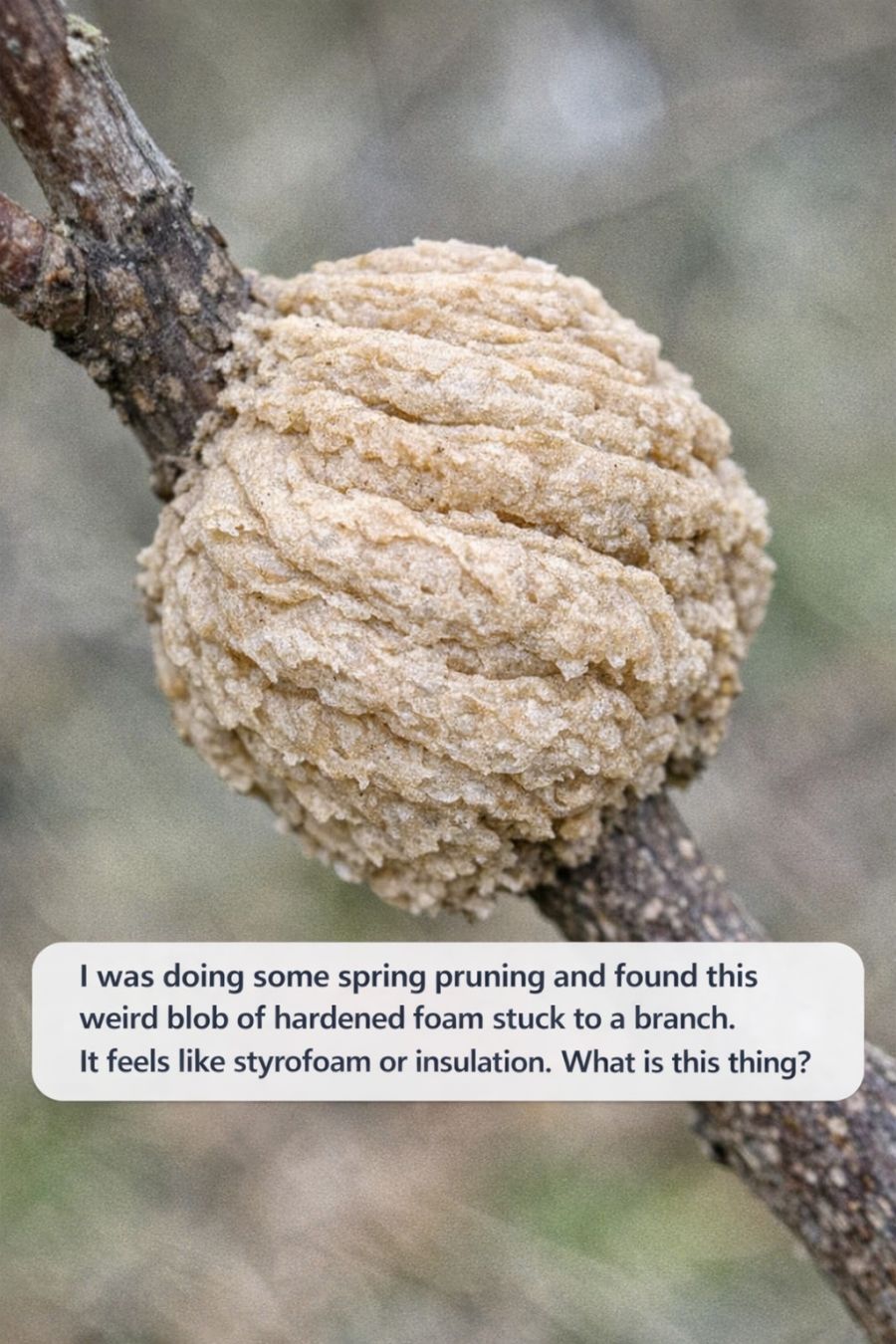
As the chill of winter begins to thaw and the first signs of spring emerge, many avid gardeners eagerly take to their yards, ready to prune, plant, and prepare their gardens for the new season. It’s during these moments of spring cleaning that you might stumble upon something unexpected—a strange, hardened blob attached to a tree branch. This peculiar finding can be both intriguing and alarming, especially if it resembles something artificial like Styrofoam or insulation.
Upon closer inspection, you might wonder about the nature of this oddity. Is it a man-made object that somehow found its way into your garden, or could it be a natural occurrence? The answer lies in the fascinating world of insects, specifically the egg cases of the praying mantis. These cases, known as oothecae, serve as protective casings for the next generation of one of nature’s most skilled predators.
1. The Mystery Foam on Your Branch: First Visual Clues
Praying mantis egg cases, or oothecae, are often mistaken for something else due to their unusual appearance. These structures are typically light brown and have a texture that can be likened to Styrofoam or hardened insulation foam. Measuring between 1 to 1.5 inches in length, they are usually oval or elongated in shape.
When observing the egg case, you might notice its ribbed texture, which is a result of the female mantis secreting a frothy substance that hardens upon exposure to air. This frothy secretion is produced by specialized glands and serves as a protective barrier for the eggs against environmental threats and predators. The ootheca is often attached to branches, twigs, or even man-made structures, blending seamlessly into its surroundings.
2. Meet the Culprit: What a Praying Mantis Egg Case Really Is
The ootheca is the result of a female praying mantis’s reproductive process. After mating, the female mantis lays her eggs in a frothy mass that she secures to a stable surface. As the froth hardens, it forms a tough protective case around the eggs inside.
Inside the ootheca, hundreds of tiny eggs are neatly packed. These eggs will eventually develop into baby mantises, also known as nymphs. The ootheca’s design ensures that these eggs remain safe throughout the winter months, ready to hatch when the warmer spring temperatures arrive.
3. Why the Egg Case Looks Like Hardened Foam or Insulation
The resemblance between a mantis egg case and hardened foam or insulation is not coincidental. The frothy secretion that forms the ootheca serves several purposes. It acts as a protective cushion, insulating the eggs from cold temperatures and physical damage.
This frothy material is similar in consistency to expanding foam used in construction, which is why it might feel familiar to the touch. As it hardens, the material becomes rigid yet lightweight, providing a durable shield that can withstand the elements while being inconspicuous enough to evade predators.
4. How to Tell a Mantis Egg Case From Fungus, Spray Foam, or Cocoons
Distinguishing a mantis egg case from other similar structures requires careful observation. Unlike spray foam or insulation, oothecae are typically attached to natural surfaces like branches or twigs. Their color tends to match the surrounding environment, making them less noticeable.
Fungal growths, on the other hand, often have irregular shapes and colors, and they may feel softer or spongier than the hard, ribbed texture of an ootheca. Cocoon structures, created by moths or butterflies, are usually made of silk and have a more uniform, smooth appearance compared to the rough, frothy texture of a mantis egg case.
5. Where and When You’re Most Likely to Find These Weird Blobs
Praying mantis egg cases are most commonly found in gardens, forests, and areas with abundant vegetation. They are typically attached to tree branches, shrubs, or even garden fences, allowing them to blend in with their surroundings.
These cases are laid in the late summer or fall, immediately after the mating season. They remain in place throughout the winter, with the eggs inside developing slowly until they are ready to hatch in the spring. This timing ensures that the nymphs emerge when food sources, such as smaller insects, become plentiful.
6. What’s Inside: Hundreds of Baby Mantises Waiting for Spring
Inside the protective ootheca, hundreds of mantis eggs……
Read more on the second page below
